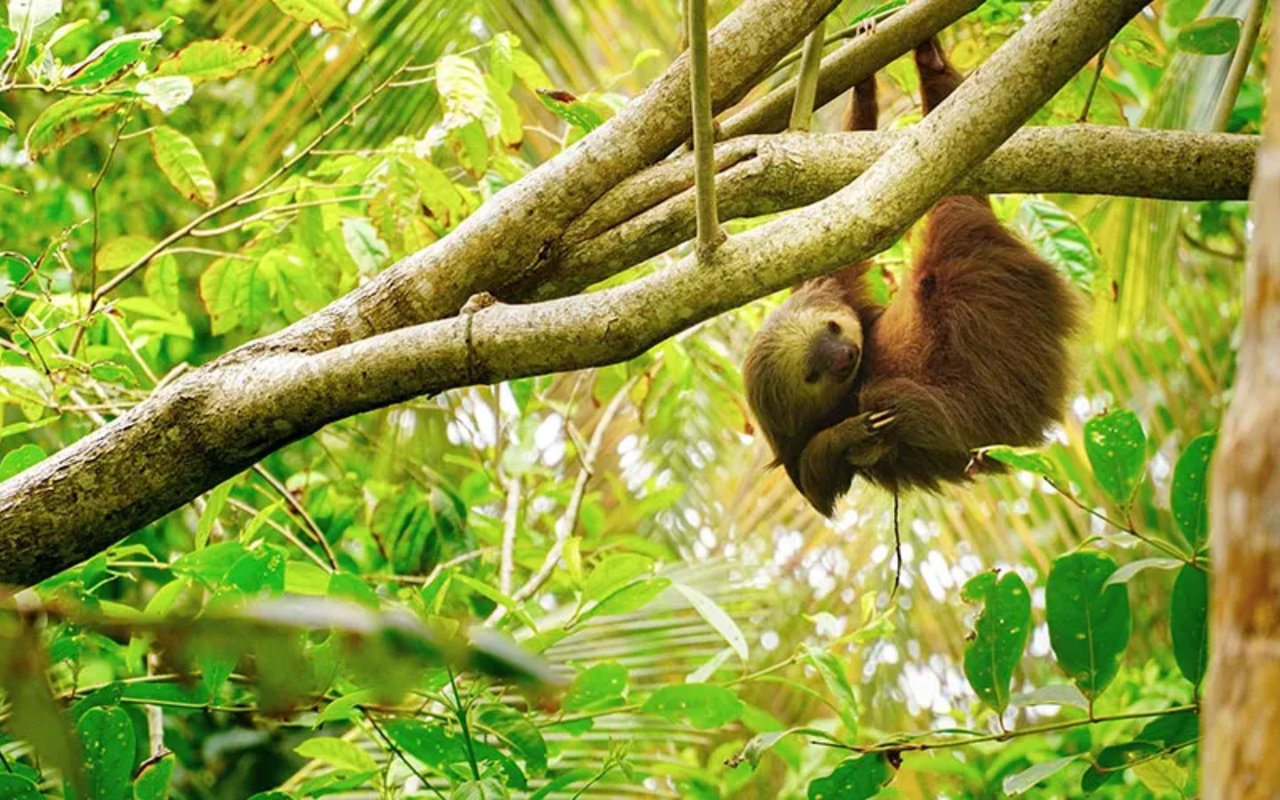
These Adorable Mammals Were Recently Recognized as One of the Country’s National Symbols, and Their Popularity Has Only Grown Since.
Be it by resting carelessly on the 10,000 colones bill, or welcoming travelers at Aeropuerto Juan Santamaría with the calming smirk of a giant statue, sloths have rapidly become one of the most internationally recognized icons of Costa Rica. For some time now, these peculiar mammals have cemented a global fanbase around their wholesome looks and nonchalant attitude, and it didn’t take long before the country itself took notice.
In 2021, local lawmakers and the president agreed unanimously to make the two-toed and three-toed sloth an official national symbol of the Central American nation, joining the white-tailed deer, the yigüirro, and the manatee as the only animals officially recognized. The decision was pretty intuitive, since Hoffmann’s two-toed sloth and Brown-throated three-toed sloths, which are the country’s native species, are one of the main highlights everyone seeks after in the different national parks, and it was made as an effort towards improving the conservation of these serene creatures.
The growing sloth popularity has to do with the internet’s discovery of these mammals’ casual appearances in Costa Rica’s daily life. The most recent example was the viral clip of a canopy interrupted by an unconcerned sloth passing through. Since the country is mostly composed of expansive natural reserves and national parks, sloths basically freely roam around most of the Costa Rican geography, and rarely do they bother about considering what humans are doing.
Before the Environment Ministry was tasked with ensuring the proper conservation of sloth species in the country, as part of their recognition as an official national symbol, many private initiatives were already built around these shaggy animals. In direct opposition to how most other countries manage wildlife in captivity, Costa Rica’s parks and reserves are the sloth’s actual environments. Refuges, resorts, and sanctuaries’ resident sloths are usually saved from human mistreatment or the effects of urbanity on their environments, and are intended to eventually return to their natural habitats.
In addition to the organic sights that tend to happen in Manuel Antonio beach, Monteverde cloud forest, and Corcovado National Park, Proyecto Asis rehab center in Arenal, Jaguar Centre refuge in Puerto Viejo, Sloth Sanctuary Buttercup Inn in Limón, and The Toucan Rescue Ranch in Heredia are institutions fully dedicated to hosting wildlife and guiding them through their reintegration process. All of these are equipped to receive tourists, and most of them offer guided tours through the premises, where sloths tend to be one of the highlights.
Be it a sporadic apparition, a well-thought-out expedition in search of them, or a personal visit to one of the many sanctuaries, Costa Rica is without a doubt the premier destination for sloth lovers worldwide.